Every SME that has looked seriously at AI tools has run into the same wall: the moment you paste a client invoice, a medical note, or a legal draft into a cloud chatbot, that data has left your control. You don’t know which server it landed on, which country that server sits in, or who else’s model gets trained on the pattern it left behind.
For most office work, that’s a risk nobody signed up for.
The Problem With “Just Use the Cloud”
Cloud AI is genuinely useful. The issue isn’t the intelligence — it’s the plumbing. Every request travels to a data center you don’t control, subject to a jurisdiction you didn’t choose, governed by a privacy policy that can change without your input. For an accountant handling client ledgers, a lawyer drafting a contract, or a clinic processing patient intake, that’s not a minor compliance footnote. It’s the whole ballgame under GDPR.
The instinct many businesses have is to simply avoid AI for anything sensitive. That’s understandable — and it also means giving up hours of automation that would otherwise be trivial to capture.
What “Local-First” Actually Means
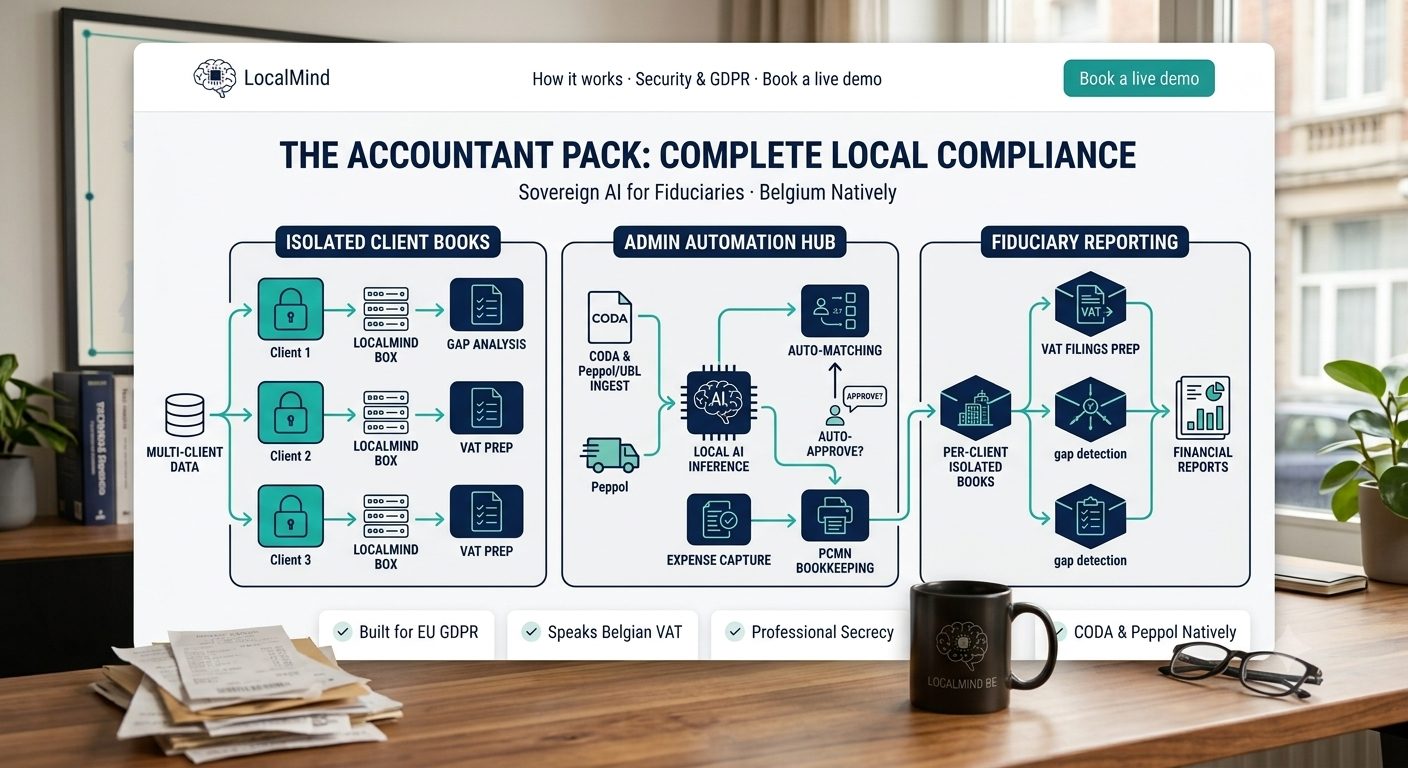
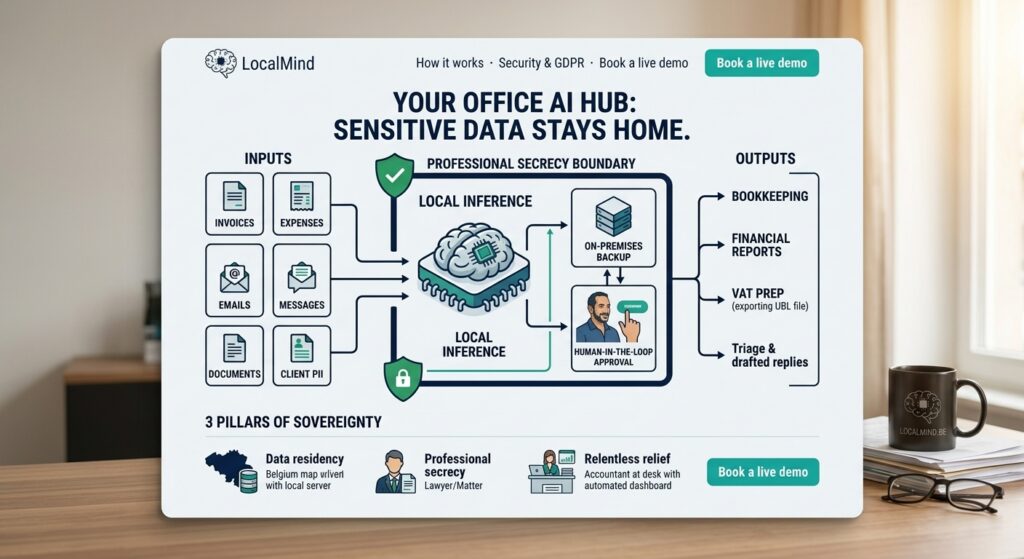
LocalMind runs the inference itself — the actual thinking part of the AI — on hardware physically inside your office or your chosen private server. Think of it as an AI hub rather than an AI subscription: your invoices, emails, documents, and client records go in, get processed, and come out the other side as bookkeeping entries, financial reports, VAT preparation, or drafted replies — without a single byte crossing the public internet to a third-party model provider.
The architecture is simple by design:
- Inputs — the documents and messages your business already generates
- Local inference — the model runs on-premises, behind your own firewall
- Outputs — structured, usable results delivered back into your existing workflow
Nothing in the middle step leaves the building. That’s not a marketing claim; it’s a network topology. There’s no API call to make to an external model for the sensitive parts, because there’s no external model in that path.
Why This Matters More Than It Used To
Three things have changed recently that make this the right moment to move to local-first AI:
Regulatory pressure is real and growing. GDPR enforcement has sharpened, and sector-specific rules (accounting confidentiality codes, medical secrecy laws, legal privilege) increasingly treat “we sent it to a cloud AI vendor” as a data transfer that needs its own legal basis — one many firms don’t have.
Local hardware finally has the horsepower. A modest on-premises GPU can now run models capable of real document understanding, extraction, and drafting — work that used to require a cloud-scale cluster.
The tooling has caught up. Local inference used to mean a raw model and a lot of duct tape. It now means a packaged appliance that installs, indexes your documents, and starts producing usable output within a day.
What You Get Without the Trade-Off
The promise of “your office AI hub” isn’t just privacy for its own sake — it’s privacy plus the automation you actually wanted:
- Financial reports and VAT prep generated from documents that never left your network
- Bookkeeping entries drafted automatically from invoices and receipts
- Draft replies to routine correspondence, reviewed by a human before anything sends
- A searchable, private index of your own business records — not a black box you have to trust blindly
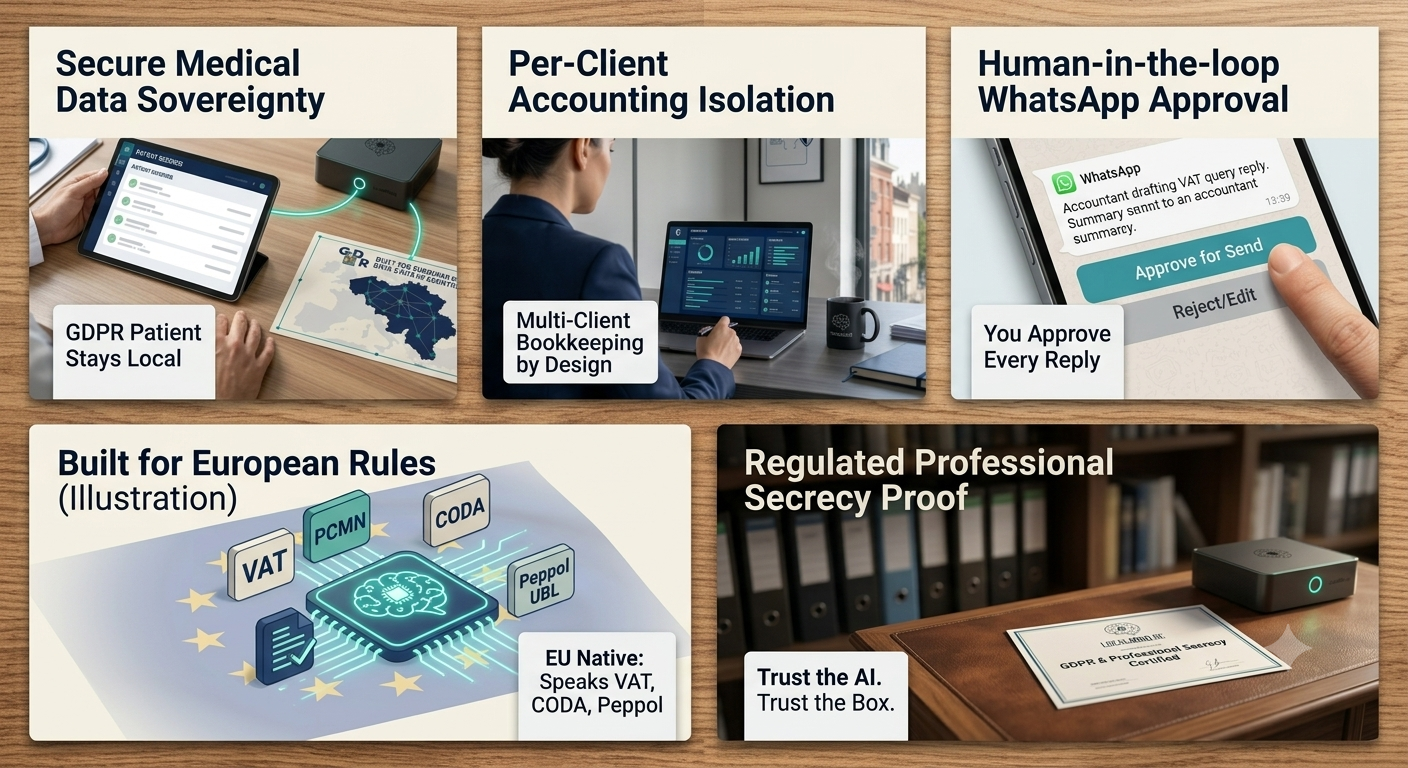
You approve every reply. You own every byte. The AI does the repetitive extraction and drafting work; you keep the judgment calls.
The Bottom Line
Cloud AI asks you to trust someone else’s infrastructure with your most sensitive material. Local-first AI asks you to trust hardware you can walk up and touch. For SMEs bound by GDPR — and especially for regulated professions — that difference isn’t a nice-to-have. It’s the only version of “AI for the office” that actually clears the bar.
LocalMind is built for exactly this: an on-premises AI appliance for GDPR-bound SMEs across Benelux, France, Germany, and Switzerland.