Every AI product on the market today defaults to the cloud. It’s the easy path — spin up an API, bill by the token, let someone else’s data center do the heavy lifting. We built LocalMind the harder way on purpose, and it’s worth explaining why, because the reasoning shapes every other decision in the product.
We Started From the Client’s Problem, Not the Model’s Convenience
LocalMind grew out of running an IT services business across multiple branches — repair, hardware, data recovery, web work — for hundreds of clients. A recurring pattern showed up early: SMEs, and especially regulated ones, wanted the efficiency gains everyone was talking about from AI, but they kept hitting the same wall when they looked closely at where their data would actually go.
An accountant doesn’t want client ledgers sitting on a third-party model provider’s infrastructure. A clinic can’t put patient notes through a general-purpose chatbot without a very uncomfortable conversation with their data protection officer. A law firm has privilege obligations that don’t bend for convenience. These aren’t edge cases — they’re most of the SME economy in regulated or semi-regulated sectors.
The cloud AI industry’s answer has generally been “trust our privacy policy” or “we’re compliant with EU data centers.” For a lot of these businesses, that answer doesn’t clear the bar their own professional obligations set. So we built the thing that does.
The Trade-Off We Accepted
Building on-premises is genuinely harder than building on the cloud. It means:
- Shipping something that has to run well on modest, real-world hardware — not an infinite cloud cluster
- Handling installation, updates, and support for physical or private-server deployments instead of a single hosted service
- Doing the engineering work to make local inference fast and accurate enough to be actually useful, not just theoretically private
We took that trade-off deliberately. A product that’s easier to build but that regulated SMEs can’t actually adopt isn’t a better product — it’s a product solving the wrong problem.
What “On-Premises” Actually Buys You
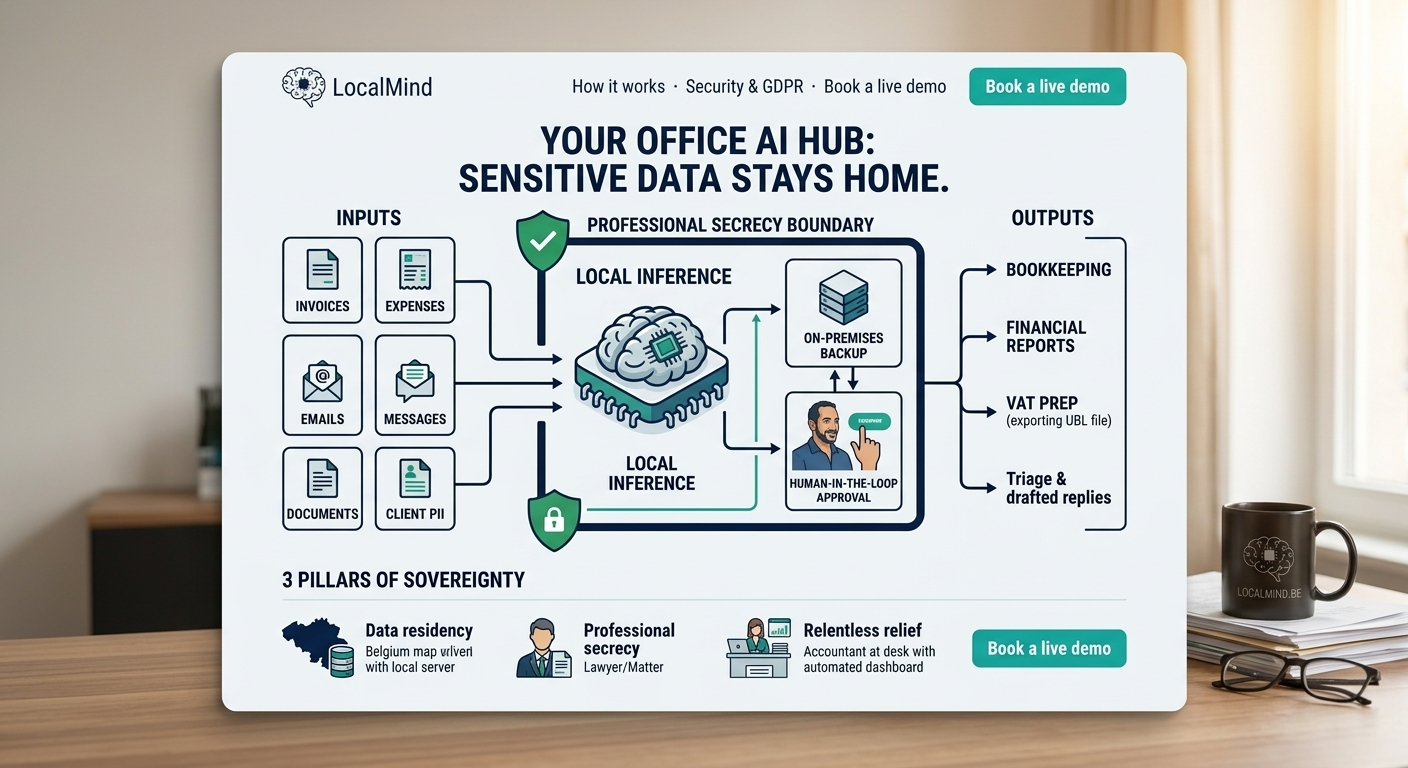
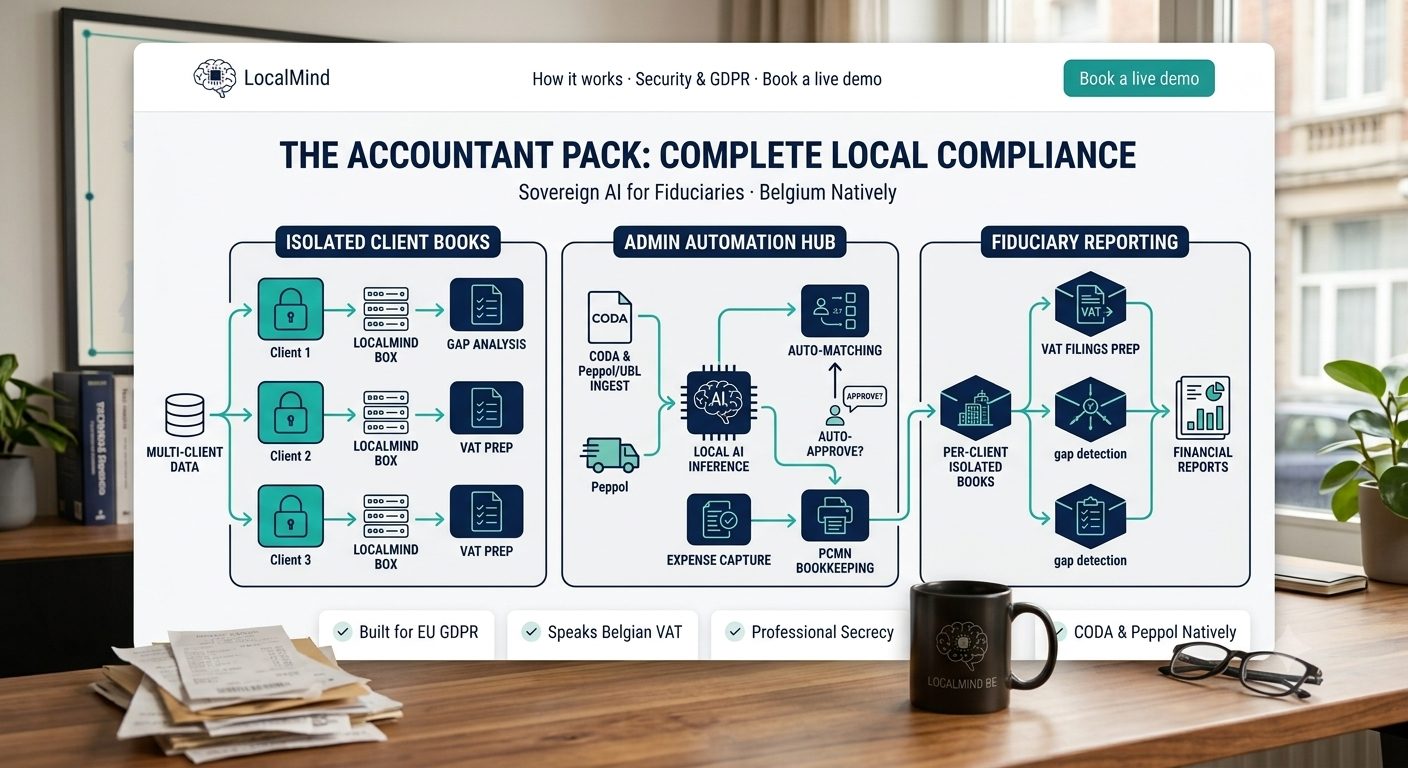
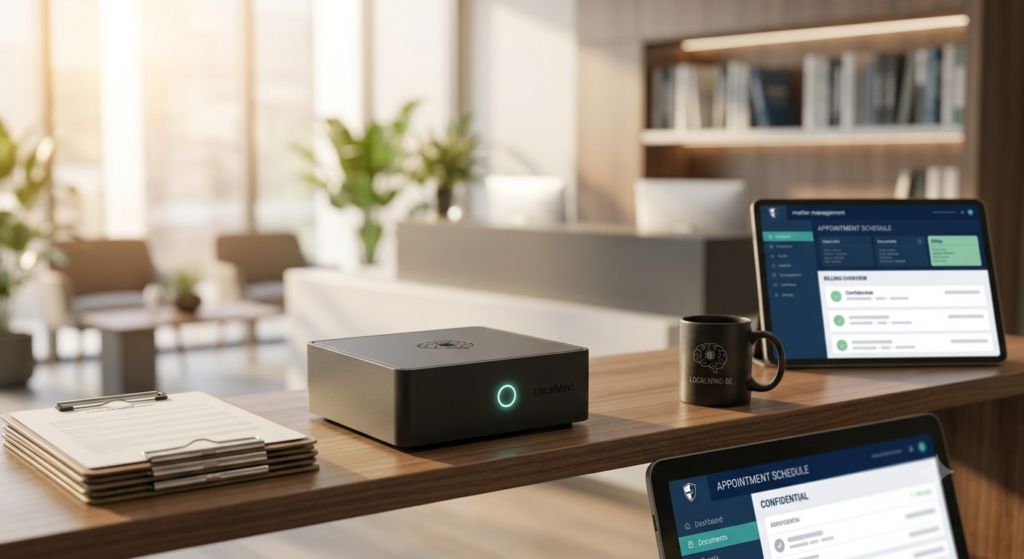
The architecture is straightforward: LocalMind runs the AI model itself on hardware inside your business — a dedicated appliance, or a private server you already control. Documents go in, get processed, and structured output comes back out, without a round trip to an external AI vendor for the sensitive parts.
That single architectural choice cascades into everything else:
- No cross-border data transfer question, because there’s no cross-border transfer
- No third party in the professional secrecy chain, because there’s no third party involved in processing
- No dependency on an external vendor’s uptime, pricing changes, or policy shifts for your core sensitive workflows
- A system you can point to — physically, in your server room — when a regulator, auditor, or worried client asks “where does our data go?”
Built in Layers, On Purpose
LocalMind’s core (what we call Bucket A) handles the general-purpose work every SME needs: document understanding, extraction, drafting, search across your own records. On top of that, vertical packs (Bucket B) — currently for accountants, legal, and healthcare — add the sector-specific structure each profession actually needs: chart-of-accounts awareness for accounting, the right document types for legal work, clinical workflow patterns for healthcare.
This layered approach means the core stays lean and well-tested, while the parts that need deep sector knowledge get built specifically for that sector instead of forced into a one-size-fits-all shape.
Who This Is For
LocalMind is aimed squarely at GDPR-bound SMEs across Benelux, France, Germany, and Switzerland — businesses that want the productivity gains of modern AI but can’t or won’t accept “trust the cloud vendor” as their compliance answer. If that’s not your situation, plenty of good cloud AI tools already exist and we’d genuinely recommend them; they’re simpler to adopt and often cheaper for low-stakes use cases.
But if your business handles client financial data, patient records, legal documents, or anything else where “where exactly does this go” is a question you need a precise answer to — that’s exactly the gap we built LocalMind to close.
The Bottom Line
We didn’t build on-premises because it was the easier engineering choice. We built it because it’s the only architecture that actually answers the question regulated SMEs keep asking: can I use AI without handing sensitive data to a third party? For LocalMind, the answer is yes — because the architecture makes it true, not because a policy document promises it.
LocalMind by RapidFix — on-premises AI for GDPR-bound SMEs across Benelux, France, Germany, and Switzerland.