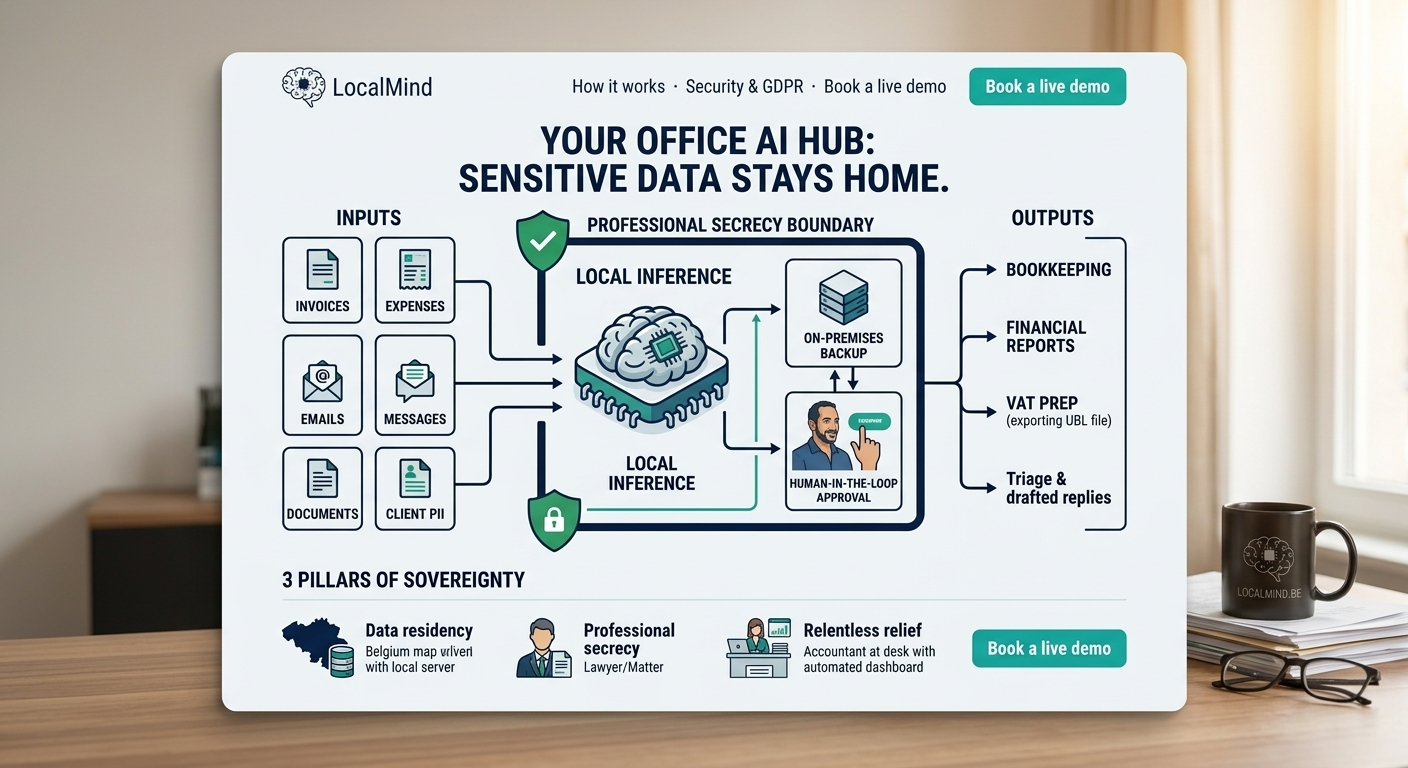
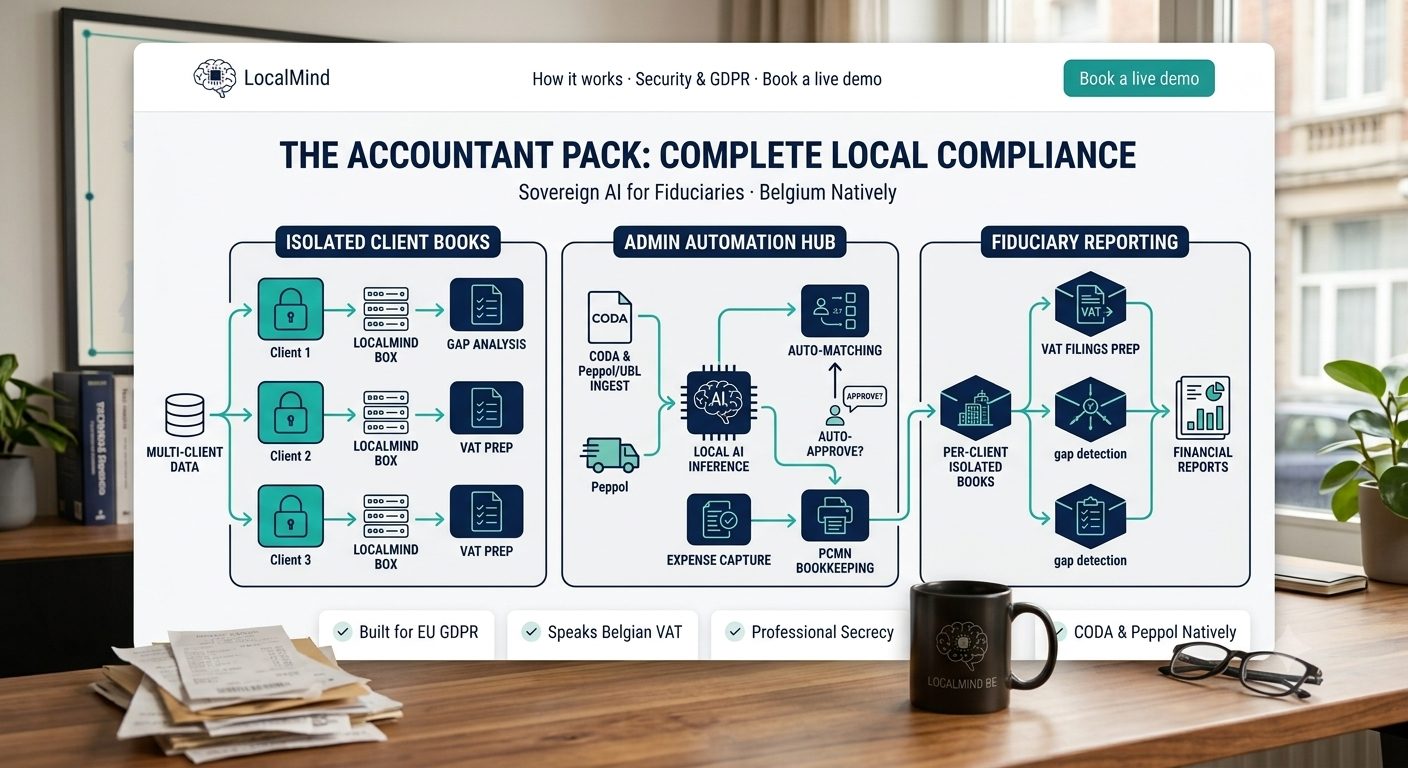
“Data sovereignty” gets used a lot in AI marketing, often as a vague promise that means whatever the vendor needs it to mean that week. We’d rather be specific. For LocalMind, sovereignty rests on three concrete pillars — each one checkable, each one a real technical or procedural guarantee rather than a slogan.
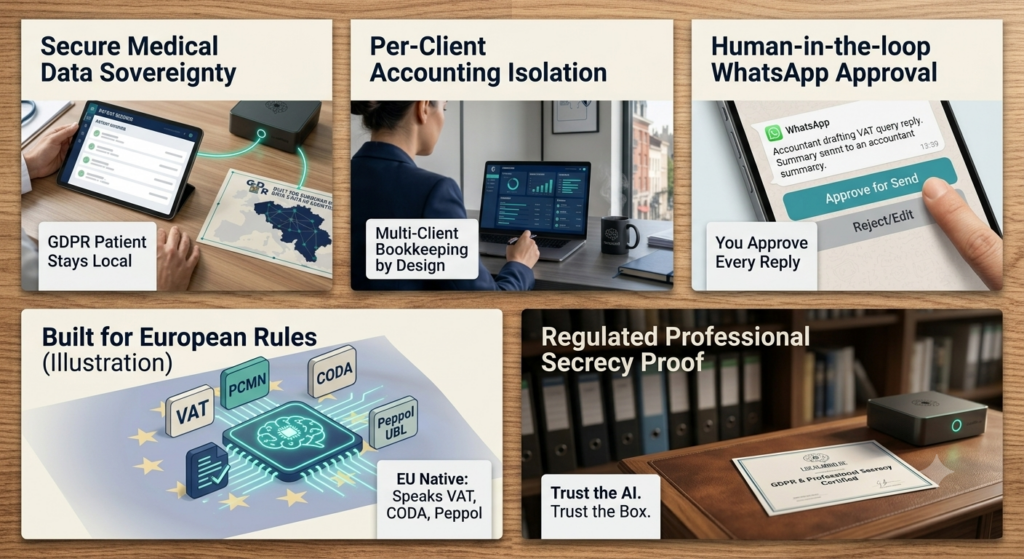
Pillar 1: Data Residency
This is the simplest pillar and the easiest to verify: your data stays on hardware you own or control, inside the country or region you choose. Not “stored in an EU data center operated by a vendor headquartered elsewhere” — physically on your premises, or on a private server under a contract you control directly.
For a Belgian SME, that means invoices, client records, and correspondence never have to cross a border to get processed by AI. There’s no cross-border data transfer question to answer, because there’s no cross-border transfer happening. GDPR’s rules on international transfers become largely irrelevant to your AI workflow, not because you’ve found a clever exemption, but because the situation they govern doesn’t arise.
This matters differently depending on your sector. A general SME cares about it as a compliance simplification. A healthcare provider or law firm cares about it because their sector-specific secrecy rules are often stricter than GDPR’s baseline, and “the AI vendor’s servers are in the EU” doesn’t automatically satisfy them.
Pillar 2: Regulated Professional Secrecy
Some professions carry legal secrecy obligations that predate GDPR and sit on top of it — medical confidentiality, legal privilege, accountants’ professional secrecy codes. These aren’t abstractions; they’re enforceable rules with real consequences for breach, and in most jurisdictions they were written without cloud AI in mind at all.
The practical question a doctor, lawyer, or accountant has to answer before adopting any AI tool is: does sending this document to a third party violate my secrecy obligation, regardless of what that third party’s privacy policy says? For many regulated professionals, the honest answer with cloud AI is “probably, or at least uncomfortably close.”
Local-first inference sidesteps the question. If the AI never leaves your infrastructure, there’s no third party in the secrecy chain to worry about. The professional’s obligation to their client or patient stays intact because the tool was built around that obligation from the start, not retrofitted to accommodate it.
Pillar 3: Trusting the AI (By Being Able to Verify It)
The third pillar is less about infrastructure and more about posture. “Trust the AI” sounds like a request for blind faith — it’s actually the opposite. Trust here means the system is built so you don’t have to take anything on faith:
- Every AI-drafted output — a reply, a categorization, a report — sits in front of a human for approval before it goes anywhere
- The system runs on hardware you can inspect, audit, or unplug
- There’s no opaque third-party model update that silently changes behavior overnight without your knowledge
This is the difference between “trust us” and “verify it yourself.” A cloud AI vendor asks for the former. A local-first appliance is built to survive the latter — you can watch what it does, because it’s doing it on your own machine.
Why These Three Together
Any one of these pillars alone is a partial answer. Data residency without human review just means the mistakes stay local instead of leaking — better, but not sufficient. Professional secrecy compliance without residency is a contradiction; you can’t credibly claim to protect client confidentiality while routing the data through a cloud model provider’s servers. And a fully local system that nobody actually reviews is just a private black box instead of a public one.
Together, the three pillars describe a specific kind of system: one where sensitive data never leaves, where the profession’s own secrecy obligations are respected by architecture rather than by policy document, and where every output is verifiable rather than trusted blindly.
The Bottom Line
Sovereignty, done properly, isn’t a feature checkbox — it’s a set of guarantees that hold up under actual scrutiny from a regulator, a professional body, or a worried client. Data residency, regulated professional secrecy, and verifiable human oversight are the three pillars LocalMind is built on, and each one is something you can check for yourself rather than take our word for.
LocalMind is an on-premises AI appliance built for GDPR-bound SMEs and regulated professions across Benelux, France, Germany, and Switzerland.