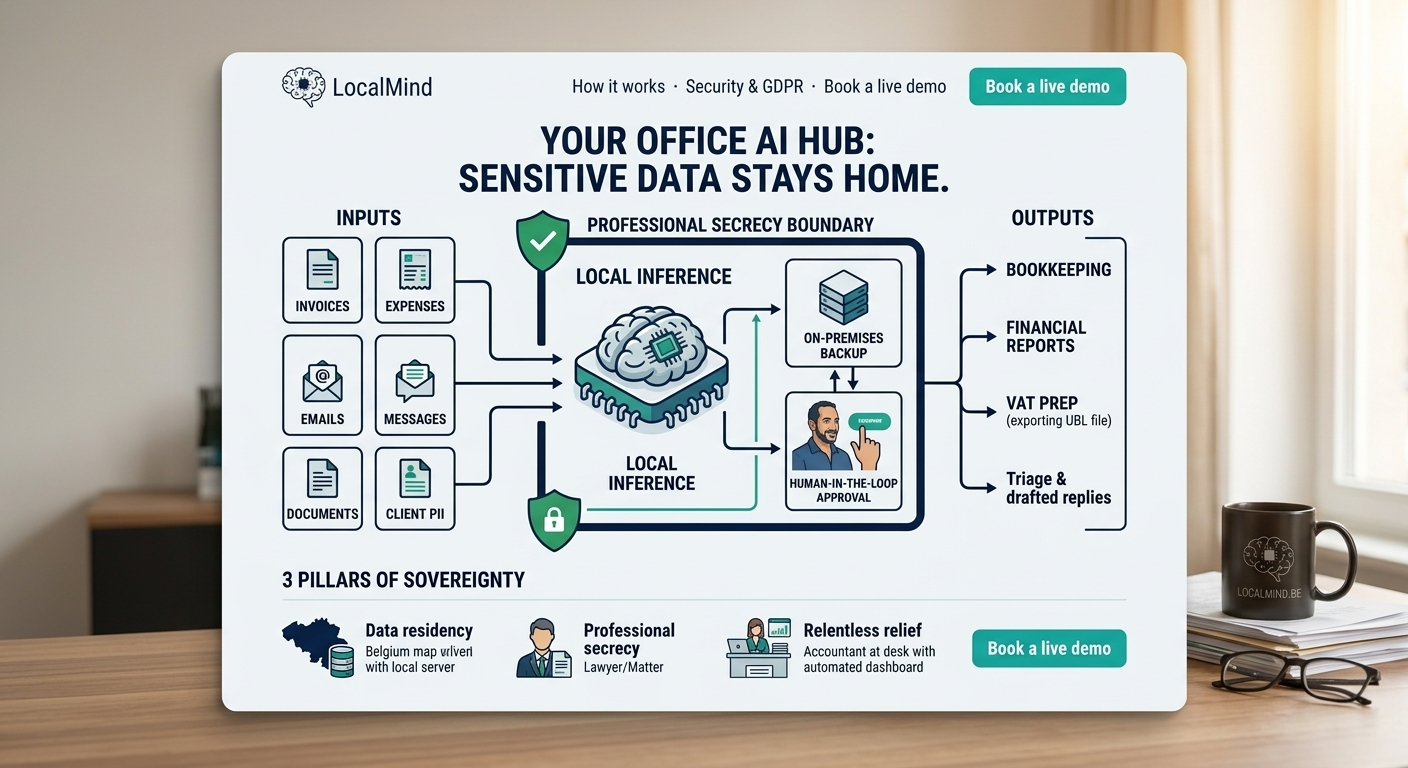
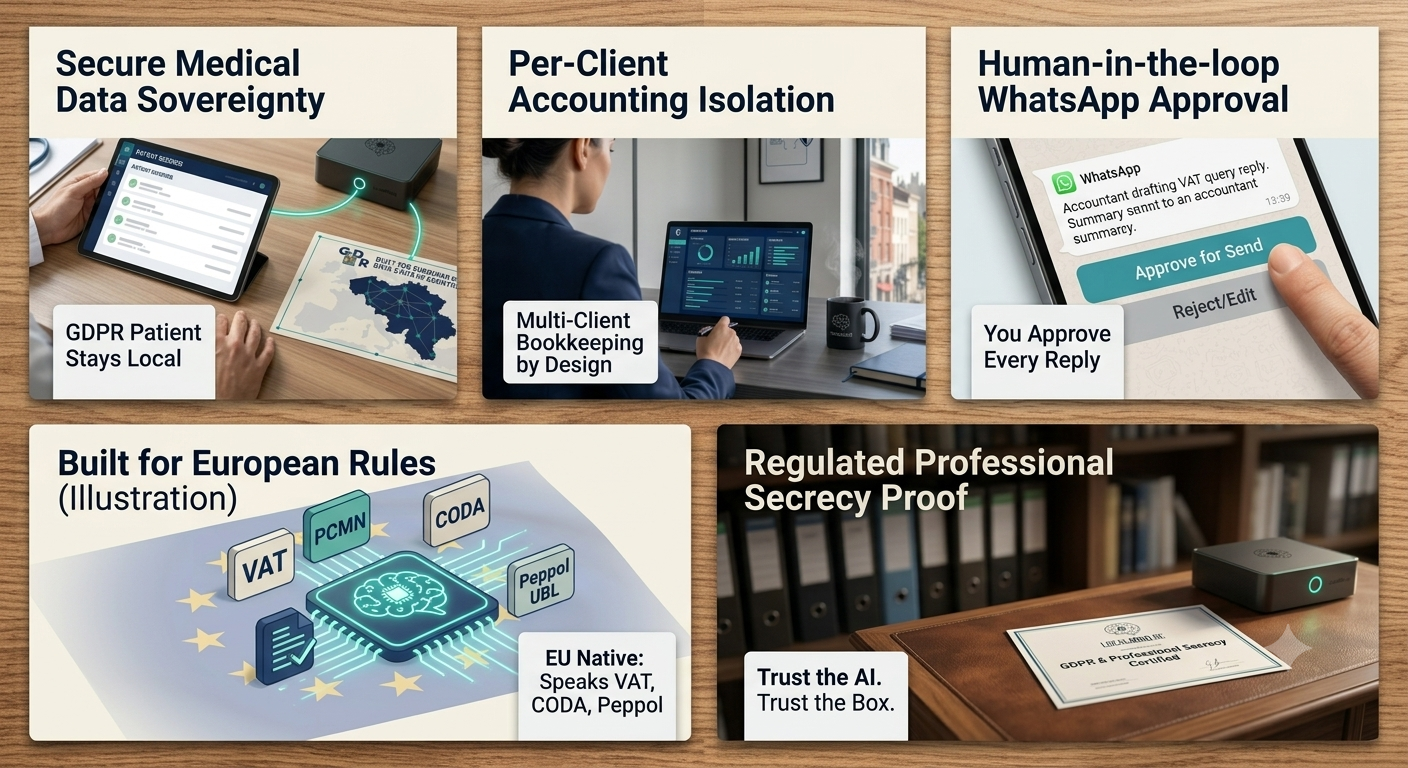
Accountants and bookkeepers sit on some of the most sensitive data in the SME economy — full financial pictures of dozens or hundreds of clients, often under strict professional secrecy rules on top of GDPR. That combination makes most accounting firms cautious about AI, and rightly so. The tools that exist tend to assume one company’s data in one account. A firm managing many clients needs something structurally different.
That’s what the Accountant Pack is built to solve.
The Core Problem: Multi-Client Isolation
A generic AI tool treats “your data” as one undifferentiated pool. For a firm handling 40, 100, or 300 client files, that’s not good enough — client A’s ledger should never be visible in the same context as client B’s, even accidentally, even for a second. Professional secrecy codes in Belgium and across the EU treat this kind of cross-contamination as a real breach, not a theoretical one.
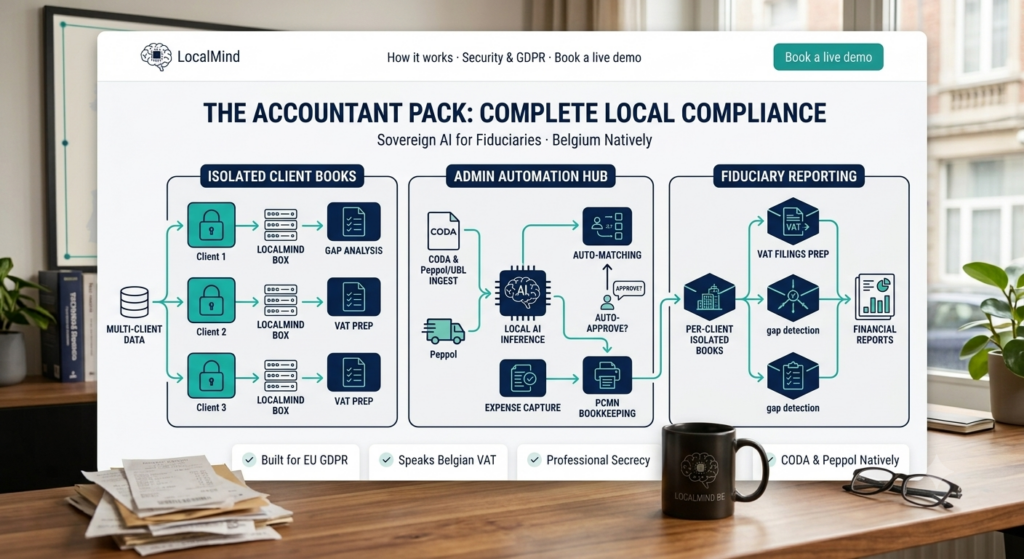
The Accountant Pack is built around per-client accounting isolation as a first-class design principle, not an afterthought bolted onto a shared database. Each client’s books live in their own walled-off space. The AI can work inside that space — extracting, categorizing, drafting — but it never reasons across client boundaries unless you explicitly ask it to.
Three Zones, One Appliance
The pack organizes the work into three areas that map onto how accounting firms actually operate:
Isolated client books. Each client’s invoices, ledgers, and source documents are processed in their own sandbox. Multi-client bookkeeping happens without cross-contamination, by construction — not by policy you have to enforce manually.
Admin automation hub. The repetitive layer — expense capture, invoice extraction, categorization, reconciliation drafts — runs locally and feeds directly into your existing bookkeeping structure. This is the same underlying engine as LocalMind’s core, tuned for accounting document types: invoices, receipts, bank statements, VAT documents.
Regulatory reporting. VAT prep, PCMN-aligned chart-of-accounts handling, and Belgian filing structures are built into the pack’s understanding of what a document is, not just what it says. Reports come out in a shape your firm already recognizes.
Human-in-the-Loop, By Design
None of this replaces your professional judgment, and it isn’t supposed to. Every draft — a categorization, a VAT calculation, a reply to a client — is exactly that: a draft. A human reviews and approves before anything is filed, sent, or finalized. The AI compresses the hours of manual extraction and first-pass drafting; you keep the sign-off, because sign-off is the part that actually requires a licensed professional.
This matters for liability as much as for quality. Your professional insurance and your registration cover your judgment. A tool that quietly auto-files things on your behalf puts that arrangement at risk. A tool that drafts and waits for your yes doesn’t.
Why On-Premises Specifically Matters Here
Accounting is one of the clearest cases where the local-first architecture isn’t a preference — it’s close to a requirement. Client financial data crossing to a third-party cloud AI vendor raises real questions under both GDPR and professional secrecy obligations that many firms haven’t fully worked through yet, because most AI vendors haven’t given them an alternative.
Running the inference on hardware inside your firm — or on a private server you control — sidesteps that question by removing the data transfer entirely. There’s no vendor data-processing agreement to negotiate for the sensitive part, because the sensitive part never leaves.
What This Looks Like Day to Day
- Invoices and receipts arrive, get OCR’d and categorized automatically, per client
- Draft bookkeeping entries appear for review, already matched to the right client’s isolated ledger
- VAT prep and reporting drafts are generated in familiar formats, ready for a final check
- Nothing about any client’s financial picture is visible outside that client’s own space — including to the AI itself, structurally
The Bottom Line
Accounting firms don’t need generic AI. They need AI that understands multi-client confidentiality as a hard boundary, keeps every draft subject to human approval, and never asks the firm to trust a third party with client books. The Accountant Pack is LocalMind’s answer to that specific, well-known problem — built on the same on-premises foundation as the rest of the platform, tuned for how accounting practices actually work.
The Accountant Pack is one of LocalMind’s vertical packs, built on the core LocalMind appliance for GDPR-bound SMEs across Benelux, France, Germany, and Switzerland.